

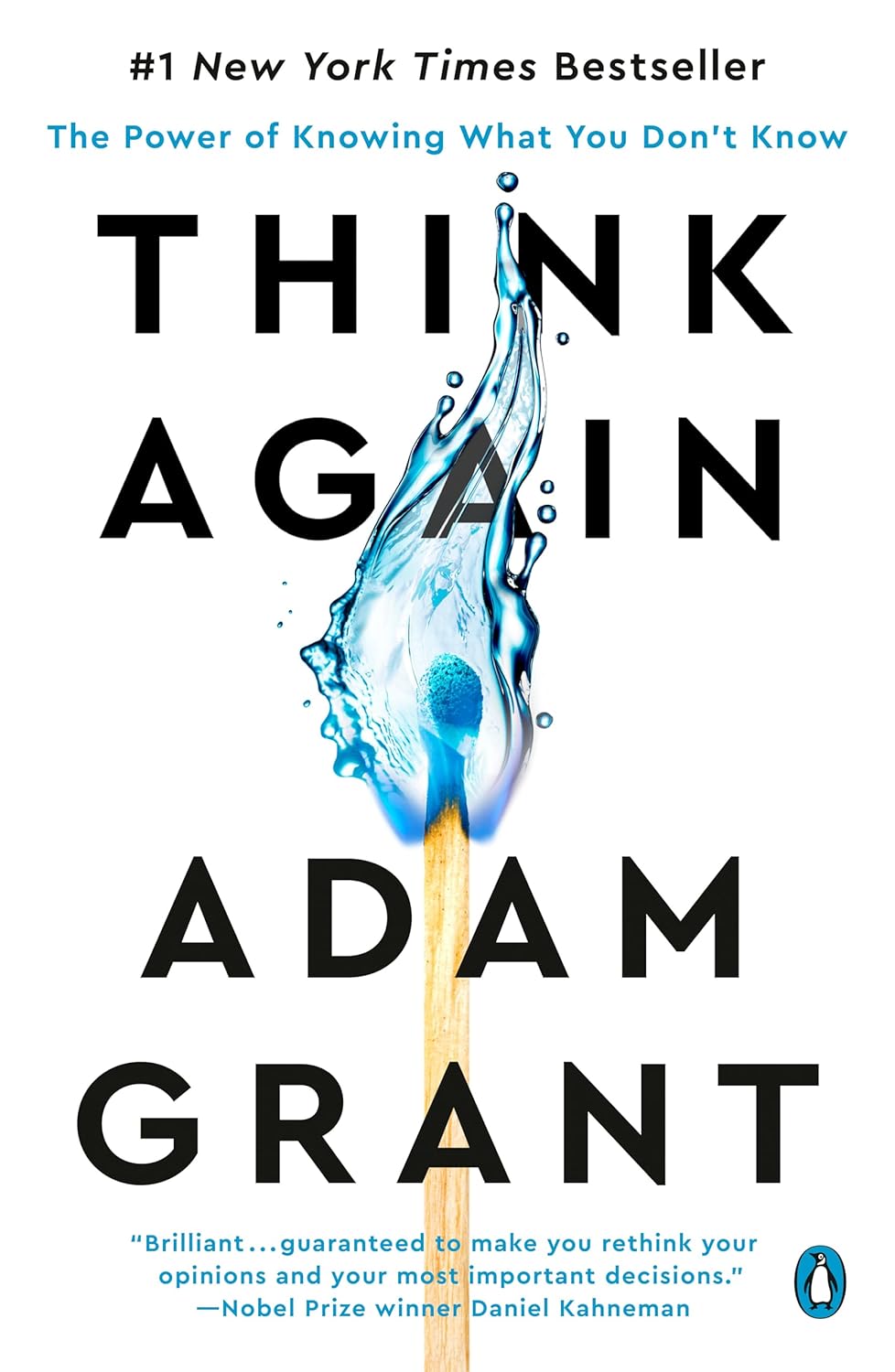

#1 New York Times Bestseller
“THIS. This is the right book for right now. Yes, learning requires focus. But, unlearning and relearning requires much more—it requires choosing courage over comfort. In Think Again, Adam Grant weaves together research and storytelling to help us build the intellectual and emotional muscle we need to stay curious enough about the world to actually change it. I’ve never felt so hopeful about what I don’t know.”
—Brené Brown, Ph.D., #1 New York Times bestselling author of Dare to Lead
The #1 New York Times bestselling author of Hidden Potential, Originals, and Give and Take examines the critical art of rethinking: learning to question your opinions and open other people’s minds, which can position you for excellence at work and wisdom in life
Intelligence is usually seen as the ability to think and learn, but in a rapidly changing world, there’s another set of cognitive skills that might matter more: the ability to rethink and unlearn. In our daily lives, too many of us favor the comfort of conviction over the discomfort of doubt. We listen to opinions that make us feel good, instead of ideas that make us think hard. We see disagreement as a threat to our egos, rather than an opportunity to learn. We surround ourselves with people who agree with our conclusions, when we should be gravitating toward those who challenge our thought process. The result is that our beliefs get brittle long before our bones. We think too much like preachers defending our sacred beliefs, prosecutors proving the other side wrong, and politicians campaigning for approval–and too little like scientists searching for truth. Intelligence is no cure, and it can even be a curse: being good at thinking can make us worse at rethinking. The brighter we are, the blinder to our own limitations we can become.
Organizational psychologist Adam Grant is an expert on opening other people’s minds–and our own. As Wharton’s top-rated professor and the bestselling author of Originals and Give and Take, he makes it one of his guiding principles to argue like he’s right but listen like he’s wrong. With bold ideas and rigorous evidence, he investigates how we can embrace the joy of being wrong, bring nuance to charged conversations, and build schools, workplaces, and communities of lifelong learners. You’ll learn how an international debate champion wins arguments, a Black musician persuades white supremacists to abandon hate, a vaccine whisperer convinces concerned parents to immunize their children, and Adam has coaxed Yankees fans to root for the Red Sox. Think Again reveals that we don’t have to believe everything we think or internalize everything we feel. It’s an invitation to let go of views that are no longer serving us well and prize mental flexibility over foolish consistency. If knowledge is power, knowing what we don’t know is wisdom.
From the Publisher


Think Again Review: Is This Adam Grant’s Most Important Book Yet?
In a world drowning in information yet starved for wisdom, holding onto our beliefs can feel like grabbing a life raft. We find comfort in conviction and safety in certainty. But what if our greatest strength isn’t in knowing, but in our willingness to *rethink* what we thought we knew? This is the provocative and profoundly necessary question at the heart of Adam Grant’s masterpiece, “Think Again: The Power of Knowing What You Don’t Know.” As avid readers and reviewers, we see countless books on self-improvement, but this one feels different. It isn’t just about learning new things; it’s about the crucial, and often uncomfortable, skill of unlearning. This is our in-depth Adam Grant Think Again review, where we’ll explore if this book is the mental upgrade we all need right now.
We’ll dive into the core concepts, dissect who this book is truly for, and weigh its game-changing insights against its potential challenges. Is it just another psychology book, or is it a practical guide to becoming wiser, more innovative, and more connected in a polarizing world? Let’s find out.
In a World of Conviction, Adam Grant Argues for Doubt
The premise of “Think Again” is both simple and revolutionary. Grant, an organizational psychologist and Wharton’s top-rated professor, argues that in a rapidly changing world, our ability to rethink and unlearn is more critical than raw intelligence. We often get stuck in mental modes that hinder our growth. We preach our own beliefs, prosecute those who disagree, and politic for approval. What we should be doing, Grant suggests, is thinking more like scientists—embracing curiosity, welcoming doubt, and seeking out evidence that contradicts our hypotheses. It’s about finding the joy in being wrong and valuing humility over pride.
The Core Idea: Trading the Preacher, Prosecutor, and Politician for the Scientist
The most powerful framework in “Think Again” is the identification of the mental roles we adopt in our daily lives. Grant brilliantly breaks them down, allowing us to see ourselves and others in a new light. Understanding these roles is the first step toward change.
👨🏫 The Preacher Mode
When our sacred beliefs are challenged, we often go into “Preacher Mode.” Our goal is not to learn or understand, but to proselytize and protect our worldview. We deliver sermons on why we are right, supported by our favorite talking points. This mode shuts down any possibility of genuine dialogue or rethinking, as the primary objective is to convert, not to connect.
⚖️ The Prosecutor Mode
When we spot flaws in other people’s reasoning, we switch to “Prosecutor Mode.” Here, the mission is to win an argument and prove the other side wrong. We marshal evidence, attack their logic, and aim to discredit their position entirely. This adversarial approach creates winners and losers, but rarely leads to shared understanding or progress. It’s about defeating an opponent, not discovering the truth.
🗳️ The Politician Mode
Seeking to win over an audience, we enter “Politician Mode.” We lobby for approval and seek to gain the support of our constituents (our friends, colleagues, or social media followers). Our opinions can become more flexible, but not in the pursuit of truth—rather, in the pursuit of popularity and acceptance. This mode is about looking good, not being good.
🔬 The Scientist Mode
This is the mindset Grant encourages us to cultivate. In “Scientist Mode,” we don’t let our ideas become our identity. We treat our beliefs as hypotheses to be tested. We actively search for reasons why we might be wrong. We are driven by curiosity, we favor humility over pride, and we see disagreement not as a threat, but as an opportunity to learn and refine our thinking. This mode is the engine of all progress and wisdom.
What Makes “Think Again” a Game-Changer: A Deep Dive
This book isn’t just a collection of theories; it’s a masterclass in applying them. Grant weaves together compelling research, fascinating stories, and practical advice that makes the process of rethinking feel both accessible and exciting. Here’s what truly stands out.
Engaging Storytelling That Sticks With You
Grant is a phenomenal storyteller. He illustrates his points not with dry data, but with vivid narratives. You’ll read about a Black musician who persuades white supremacists to abandon hate, an international debate champion who wins by finding common ground, and a “vaccine whisperer” who helps concerned parents rethink their stance. These stories are not just interesting; they are emotional, memorable, and provide a blueprint for how to have more productive, nuanced conversations in our own lives.
Actionable Frameworks and Practical Advice
Beyond the stories, the book is packed with actionable takeaways. Grant provides concrete strategies for everything from building a “challenge network” (a group of people you trust to challenge your thinking) to how to argue more effectively by listening like you’re wrong. He offers techniques for motivating others to rethink, creating learning cultures at work and at home, and recognizing the “overconfidence cycle.” It’s a toolkit for intellectual and emotional growth.
The Liberating “Joy of Being Wrong”
Perhaps the most profound takeaway is the reframing of what it means to be wrong. In our culture, being wrong is often seen as a failure. Grant reframes it as a discovery. The moment you realize you were wrong about something is the moment you become less wrong than you were before. He argues that we should take as much delight in discovering our own errors as we do in being right. This shift in perspective is incredibly liberating and is the foundation for lifelong learning.
Who Should Read “Think Again”? (And Who Might Skip It)
While the principles in this book are universal, it will resonate more deeply with some than others. Here’s our breakdown of who stands to gain the most from this read.
This book is an absolute MUST-READ for:
- Leaders and Managers: Learn how to build a culture of psychological safety where teams feel comfortable challenging the status quo and admitting mistakes, leading to better innovation and decision-making.
- Educators and Parents: Discover methods to teach children *how* to think, not just *what* to think, fostering curiosity and critical thinking skills for life.
- Anyone in a Polarized Environment: If you find yourself frustrated with political, social, or family disagreements, this book provides a roadmap for more constructive conversations.
- Creatives and Entrepreneurs: The ability to pivot, unlearn old assumptions, and rethink your strategy is the lifeblood of innovation. This book is your guide.
- Lifelong Learners: If you are genuinely committed to personal growth, “Think Again” will provide you with a new mental operating system to accelerate your journey.
You might consider skipping this book if:
Honestly, it’s hard to find someone who wouldn’t benefit. However, if you are looking for a simple, quick-fix “life hack” book, this isn’t it. The concepts are easy to understand but require genuine effort and humility to implement. It’s a book that challenges you to do real inner work, not just apply a new productivity technique.
A Critical Look: Potential Drawbacks and Considerations
No Adam Grant Think Again review would be complete without a balanced perspective. While we overwhelmingly recommend the book, there are a couple of points to consider.
A Focus on the Professional World
Many of the examples and studies are drawn from the world of business, leadership, and professional organizations. While Grant does an excellent job of showing how these lessons apply to personal life, a reader with no connection to the corporate world might find some chapters less directly relatable than others.
The Challenge of Implementation
The core message—be humble, embrace being wrong, think like a scientist—is inspiring. However, putting it into practice in the heat of a real-world argument is incredibly difficult. Our egos, emotions, and ingrained habits are powerful forces. Reading the book is the first step, but true mastery of its principles is a lifelong practice that requires significant self-awareness and discipline.
How “Think Again” Compares to Other Mindset Books
How does “Think Again” stack up against other giants in the genre? Here’s a quick comparison to help you understand its unique place on the bookshelf.
Think Again vs. “Mindset” by Carol Dweck
“Mindset” famously introduced the world to the idea of a “fixed” vs. “growth” mindset. It’s the foundational text on the belief in one’s ability to learn and improve. “Think Again” builds on this by providing the *tools* for how to operate with a growth mindset. It’s the practical “how-to” guide for Dweck’s “what.” If “Mindset” is the diagnosis, “Think Again” is the prescription.
Think Again vs. “Atomic Habits” by James Clear
“Atomic Habits” is the definitive guide to building better systems and processes for behavior change. It’s about the mechanics of habit formation. “Think Again” operates at a level above that—it’s about changing the underlying beliefs and mental models that *drive* your habits and decisions. The two books are highly complementary: use “Atomic Habits” to build a habit of daily rethinking that “Think Again” teaches you.
Frequently Asked Questions (FAQ)
Not at all. Despite being based on rigorous psychological research, Adam Grant’s writing style is incredibly accessible, engaging, and story-driven. It reads more like a captivating conversation than a textbook. He makes complex ideas feel simple and relevant.
That your identity should be anchored in your values (like curiosity and humility), not in your opinions. When you detach your sense of self from your beliefs, you become free to change your mind without feeling like you’ve lost a part of yourself. This is the key to true intellectual freedom.
Yes, there is an audiobook version of “Think Again,” and it’s fantastic. It is narrated by Adam Grant himself, along with a cast of other voices for quotes and stories, which makes for a dynamic and engaging listening experience. If you’re an audiobook fan, this one is highly recommended.
Start small. The next time you feel a strong emotional reaction to a differing opinion, pause. Instead of formulating your rebuttal, ask a genuine question: “What makes you feel that way?” or “Can you help me understand your perspective better?” Shift from prosecutor to curious scientist, just for a moment, and see what happens.
The Final Verdict: Should “Think Again” Be On Your Bookshelf?
After a thorough analysis for this Adam Grant Think Again review, the answer is an unequivocal and resounding YES. This is more than just a good book; it’s an important one. It’s a desperately needed antidote to the certainty and polarization that define our modern world. It provides the tools to not only become more intelligent but to become wiser.
Reading “Think Again” feels like getting a new operating system for your mind—one that runs on curiosity, is updated by evidence, and is secured by humility. It won’t just change how you think about your own opinions; it will change how you engage with the world and the people in it. If you believe that learning is a lifelong process, then unlearning and rethinking are the most critical skills you can develop. This book is your essential guide.
Investing in your mindset is one of the most powerful steps you can take toward personal and professional success. For more curated recommendations, explore our guide to the best non-fiction books for personal growth to continue your journey.